
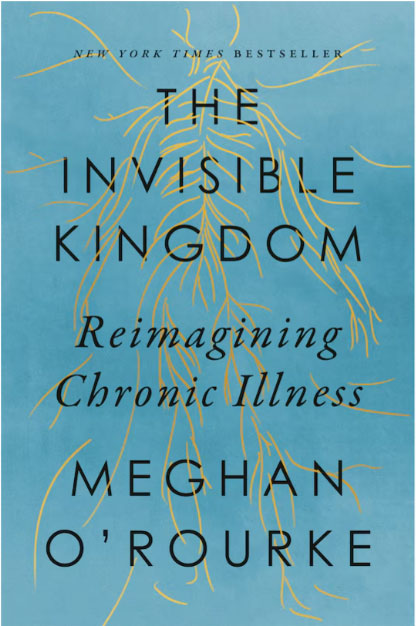
In The Invisible Kingdom, Meghan O’Rourke offers both a scientific exploration and a deeply personal account of living with chronic illness. Structured in three parts—Obstacles, Mysteries, and Healing—the book traces her years-long struggle with baffling, debilitating symptoms that defied diagnosis and understanding. Her experience mirrors that of millions navigating a medical system ill-equipped to address complex, chronic conditions.
Reading her story often feels like “looking into a mirror”—trying to name symptoms and seek help while battling fatigue, pain, and brain fog, with no guarantee of answers. O’Rourke gives voice to the “silent epidemic” of chronic illness affecting tens of millions in North America, especially those who are most often overlooked: women, the working class, and people of colour.
“I wanted recognition of the reality of my experience,” she writes, “a sense that others saw it, not least because human ingenuity might then be applied to the disease that had undone me, so that others might in the future suffer less than I did.”
Drawing from a decade of research and interviews with doctors, patients, and scientists, O’Rourke challenges long-held assumptions in Western medicine that favour acute, easily diagnosed conditions. She argues that our current system is
poorly equipped to deal with illnesses that lack clear origins or straightforward treatments.
“The ill are busy trying to formulate a story to help them navigate their new identity,” she writes. “Being ill, after all, is unwelcome, foreign, confusing. It interrupts your plans for the present and, when you are chronically ill, your plans for the future. But at first very little is clear to the patient, and that lack of understanding–of control–is terrifying. And so the patient invests time and effort trying to figure out a new story; she wants someone to help write that new story by making space for the loss that has occurred, the harm done, and by seeing it as the unique loss it is.”
Ultimately, The Invisible Kingdom offers more than a memoir—it’s a call for a new medical paradigm and a compassionate understanding of chronic illness. As she writes, “What does it mean for a chronically ill patient to heal? In some cases, it may mean remission of the disease. But in others, it means the patient is now able to manage the illness with some degree of integrity.”