
Diagnosis Summary
In the last quarter, Lupus Ontario launched a Patient Experience Survey to better understand the impact of lupus on lupus patients and their caregivers. Each month, we will share a section of the survey findings.
A big THANK YOU to everyone who took the time to respond to our survey. Total survey responses received were 159 of which 16 did not complete the survey resulting in 143 responses. This information will be invaluable to our advocacy efforts in improving the quality of life for lupus patients.
DEMOGRAPHICS
Over the next several months we will be running articles in the newsletter on key findings based on your responses. Below is a demographic overview of survey respondents; where they lived, who responded, what type of lupus they have and their overall health condition.
Where Respondents Lived
The survey respondents were geographically spread throughout Ontario and surrounding areas. The largest number of survey respondents were from Southwest Ontario at 23.3%, followed by Central Ontario at 16.4%, then the City of Toronto at 15.1%; the fewest were from the Far North.
The majority, or 91.2% of survey responders were lupus patients and 6.3% were caregivers on behalf of lupus patients: 97.2% were female and 79.7% identified as white. For medical information on lupus, survey respondents relied on multiple resources such as their physician, patient organizations and online resources.
Who Responded
Survey respondents spanned a wide range of ages: 51.8% of respondents were between 46 and 64, with another 29.4% falling within the 16 to 45 age range. In total, 81.2% of respondents are in their prime years which are typically devoted to education, career growth, and family building. Yet lupus significantly disrupts these plans: only 31.5% are employed full‑time and 13.3% employed part‑time, while 55.9% are either on disability, unemployed, or retired due to the disease.
|
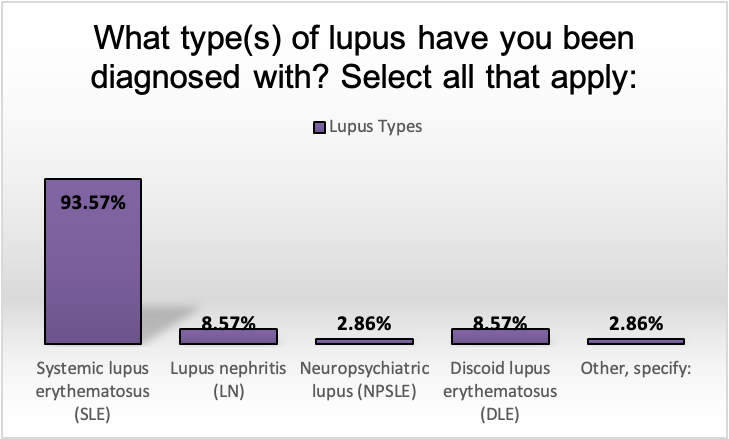
The majority of survey respondents, or 93.6% were diagnosed with Systemic Lupus Erythematosus (SLE) with a number of respondents having more than one type of lupus. |
 |
Overall Health Condition of Respondents
Survey respondents ranked the severity of their disease on a scale of mild, moderate and severe. Mild lupus symptoms were experienced by 36.4% of survey respondents with moderate symptoms experienced by 54.3% with severe symptoms experienced by 9.3%.
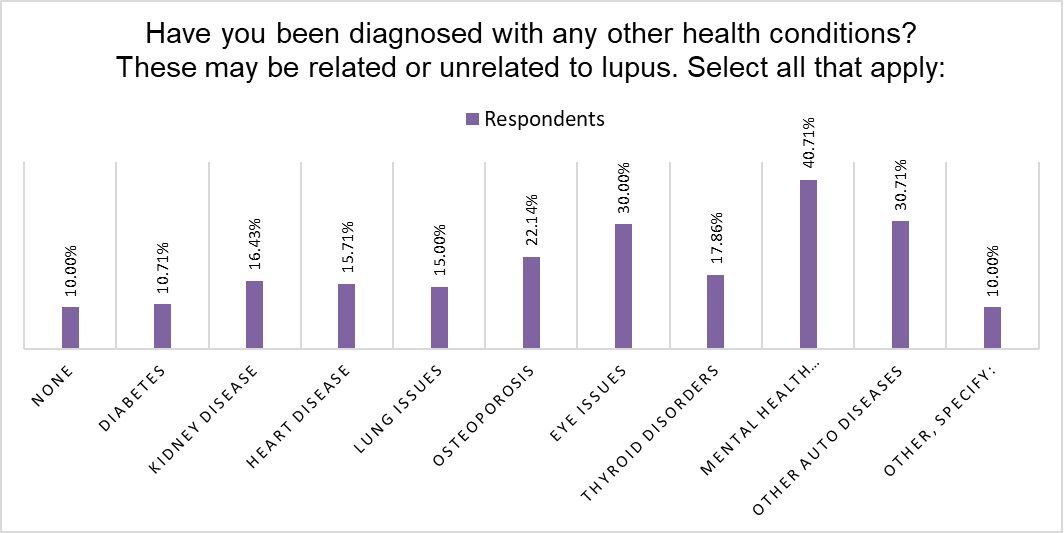
In addition, the majority or 90% of survey respondents have been diagnosed with other health conditions and comorbidities. Therefore, managing lupus patients becomes a much more complex exercise with multiple specialists involving different treatment plans. The top two conditions noted by respondents were mental health conditions such as depression and anxiety were experienced by 40.7% with 30.7% had other autoinflammatory/autoimmune diseases. Please see chart with breakdown of all other health conditions.
Survey respondents rated the severity of their symptoms on other health conditions against the severity of their lupus symptoms: 37.6% rated them comparable to their lupus symptoms, 35.2% found them milder and 27.2% rated their other health condition symptoms as more severe than their lupus symptoms.
Conclusion
81.2% of respondents are in their prime years which are typically devoted to education, career growth, and family building. Yet lupus significantly disrupts these plans with only 31.5% employed full-time. The impact of this disease on lupus patients and the significant mismatch between personal goals set and achieved has a lasting impact on the quality of life faced by lupus patients.
Additionally, the complexity of managing this disease is further compounded by the other health conditions and comorbidities present exponentially expanding the health team necessary to manage a single lupus patient.
Future articles will explore in detail the disease impact on quality of life and the effectiveness of medications and treatments.