
Lupus Ontario Patient Experience Survey: Flares and Hospitalization
At the end of 2025, Lupus Ontario launched a Patient Experience Survey to better understand the impact of lupus on individuals living with the disease and their caregivers. Below are the key findings from the third section of the survey.
Flares and Hospitalization: Highlights
- Flares are frequent: Over half of patients flare monthly or quarterly.
- Hospitalizations are common: 44.7% of respondents who answered the flare-related questions have been hospitalized as a result of a flare, many multiple times.
- Recovery is demanding: Most rely on rest, stress reduction, and avoiding sun exposure to recover from a flare.
Detailed Findings
Flares
When lupus flares, patients often go from managing their disease to having their disease manage them. Sometimes the impact is marginal, such as requiring more rest to support recovery, while at other times the impact is life-altering, requiring hospitalization.
In total, 132 lupus patients responded to the survey questions related to flare frequency, triggers, and recovery. Of these, 59 (44.7%) respondents experienced hospitalization as a result of their flare.
Flare Triggers and Frequency
A variety of triggers were identified by survey respondents. The most common include:
- Stress: 72.7%
- Sun exposure: 52.3%
- Overexertion or physical stress: 50.8%
- Infection: 26.5%
- Hormonal changes: 22.7%
All other flare triggers, such as changes in medications or weather, were less common, with each identified by less than 20% of respondents. In addition, 20% of respondents indicated that they did not know what triggered their flares.
Almost 35% of respondents flare monthly, and another 21% flare quarterly, suggesting that the disease may not be well managed in over half of respondents.
Flare Recovery Solutions
Most respondents, or 87.9%, identified rest and sleep as the primary solution for recovery from a flare.
This was followed by:
- Reducing stress: 73.5%
- Avoiding sun exposure: 58.3%
The following chart ranks all recovery solutions.
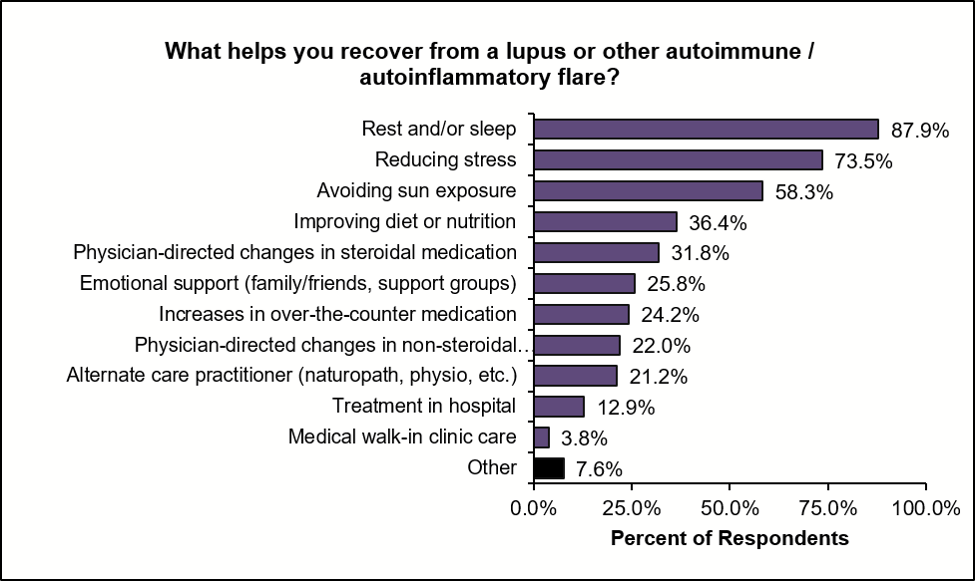
Chart: Flare Recovery Solutions
“Other” includes walking/moving, stretching, and joint injections.
Hospitalization
As mentioned above, 59 (44.7%) of respondents have experienced hospitalization as a result of their flares.
This means that almost 1 in 2 lupus patients who responded to the survey and experienced flares were hospitalized.
Hospitalization Frequency
The majority of hospitalized patients, or 72.9%, had been hospitalized 1–2 times.
- 72.9% had been hospitalized 1–2 times
- 13.6% had been hospitalized 3–10 times
- 13.6% had been hospitalized more than 10 times
Collectively, this means that more than 1 in 4 respondents who have been hospitalized have been admitted 3 to more than 10 times during their lives.
Length of Hospital Stay
More than 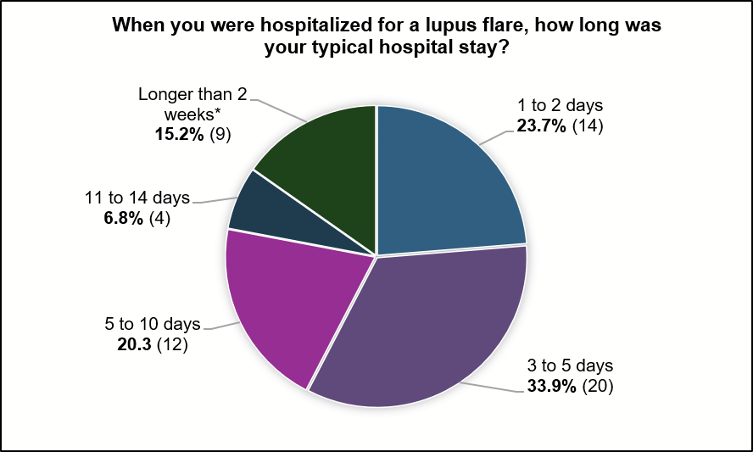 half, or 57.6%, of respondents who were admitted to the hospital stayed for 1–5 days.
Another 27.1% stayed for 6–14 days.
Just over 15% stayed for longer than 2 weeks.
Note: Most respondents who indicated they were hospitalized for longer than two weeks noted stays ranging from 1 month up to 10 months.
Conclusion
Survey findings paint a vivid picture of the profound and ongoing burden that lupus places on patients’ lives. Flares are not isolated events but recurring disruptions that affect more than half of respondents every one to three months.
These episodes are often triggered by unavoidable or difficult-to-manage factors such as stress, sun exposure, physical exertion, infections, and hormonal changes. The fact that 1 in 5 patients cannot identify their triggers underscores the unpredictable nature of the disease and the challenges patients face in anticipating or preventing flares.
Recovery from flares relies heavily on rest, stress reduction, and environmental management, reflecting significant lifestyle adjustments patients must make to regain stability. Yet even with these strategies, the severity of flares is evident: nearly 45% of respondents have experienced flares requiring hospitalization.
Among those hospitalized, a substantial proportion experienced repeated or prolonged admissions, with 1 in 4 hospitalized patients being admitted three or more times and over 15% staying longer than two weeks.
Taken together, these findings highlight a critical reality: lupus flares are frequent, disruptive, and often severe enough to require acute medical care. They impose emotional, physical, and economic strain on patients and their families, while placing a significant burden on the healthcare system. These findings are substantiated by other survey topics and will be discussed in future news articles.
The findings reinforce the urgent need for improved disease management strategies, earlier intervention, and better access to specialized care.
Explore More Patient Experience Survey Findings
Read Section 2 – Disease Impacts
Read Section 1 – Diagnosis Summary